Real-World Examples of AI Agents
Artificial Intelligence (AI) is now part of our daily life. It is not only used by big tech companies. Many offices and businesses use AI agents to make work easier and faster. These AI agents can answer customer questions, manage tasks, analyze data, and help people make better decisions. In this blog, we will share some real-world examples of AI agents and show how they are used in everyday business situations.
Goal-Based Agents
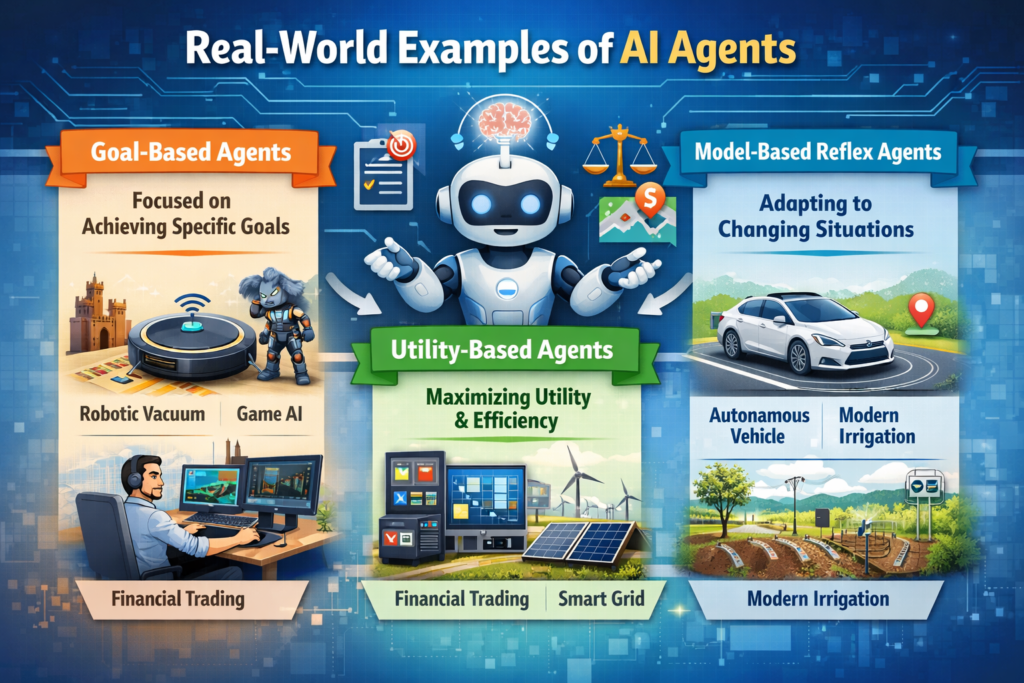
Goal-based AI agents are designed to achieve a specific goal. Normal systems can also achieve goals, but they only follow fixed rules. A goal-based AI agent can think, make decisions, and change its actions based on the situation to reach the goal. Normal systems cannot adapt or decide on their own.
Example
- Robotic vacuum cleaner
- Video Game AI
Utility-Based Agents
A utility-based agent is an AI system designed to maximize a specific utility. Additionally, the utility can be anything from maximizing profits to minimizing energy consumption. Unlike a goal-based agent, a utility-based agent doesn’t have a particular goal. Instead, we design them to find the best solution based on a specific utility.
Example
- Financial Trading
- Dynamic Pricing Systems
- Smart Grid Controllers
Model-Based Reflex Agents
Model-based reflex agents are intelligent agents that use a simple model of the world. They use past information and current inputs to understand the situation and choose actions. Unlike simple reflex agents, they can change their actions when the situation changes, even if some information is not directly visible. This helps them make better decisions, like how humans adapt to new situations.
Example
- Autonomous Vehicles
- Modern irrigation systems
Learning Agents
Learning agents are more complex agents that learn from past experiences. They improve their performance over time by adapting to new situations and changing their actions based on what they learn.
Example
- Content Recommendation
- Speech Recognition Software
Hierarchical Agents
Hierarchical agents are complex AI agents made up of multiple smaller agents. They work in different levels, where higher levels make decisions and lower levels perform specific tasks. This structure helps the system make organized and efficient decisions.
Example
- Manufacturing Robots
- Air Traffic Control Systems
Robotic Agents
Robotic agents are physical AI agents equipped with sensors such as cameras or touch sensors. They are used to perform dangerous or repetitive tasks. These agents often work with other types of AI, allowing them to carry out goal-based or utility-based tasks, sometimes as part of multi-agent or hierarchical systems.
Example
- Surgical Robots
- Service Robots
References